

Curriculum Overview & Structure
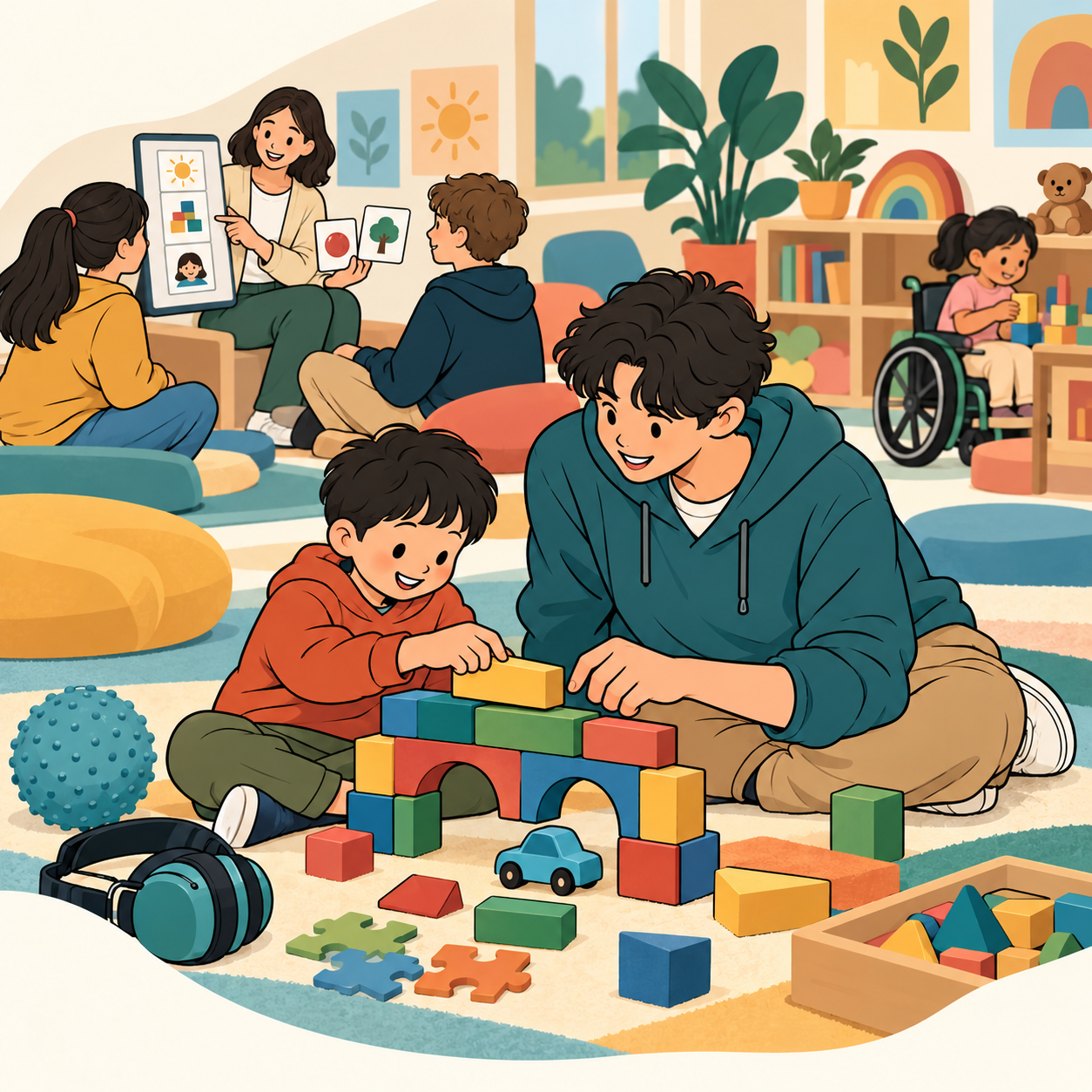
- Target Audience: High School Volunteers (Grades 9–12) serving as 1:1 buddies for individuals with developmental and physical disabilities at an Inclusive Day Play School.
- Duration: 16 Weeks (1 Session/Week, 45–60 minutes per session).
- Session Layout:
- Concept & Knowledge (15 mins): Educational, psychological, and developmental foundations.
- Scenario Discussion (20 mins): Analyzing unpredictable real-world case studies and practical interventions.
- Group Action & Practice (15 mins): Role-playing, visual tool preparation, and peer reflection.
16-Week Weekly Curriculum
Week 1: Foundations of 1:1 Mentorship & Disability Awareness
- Core Concept: Moving from a “pity/helper” mindset to “empowerment and equal partnership.” Understanding neurodiversity and adopting a “Presume Competence” approach.
- Unpredictable Scenario: At morning drop-off, your buddy refuses to get out of their parent’s car, clutches the seatbelt tightly, and screams when you approach.
- Discussion & Action Steps: Do not pull or physically force your buddy. Use a soft, neutral tone, present a visual welcome card, and give them 5–10 minutes in the vehicle to adjust to the environment.
Week 2: Non-Verbal Communication & AAC Tools
- Core Concept: Utilizing Augmentative and Alternative Communication (AAC), Picture Exchange Communication Systems (PECS), and reading non-verbal body language.
- Unpredictable Scenario: Your non-verbal buddy suddenly grabs your wrist tightly, pulls you toward a locked storage cabinet, and begins whining loudly.
- Discussion & Action Steps: View the behavior as a communication attempt rather than a tantrum. Present a choice board with pictures (snack, toy, bathroom) so they can point to what they need.
Week 3: Sensory Processing & Environmental Triggers
- Core Concept: Differentiating between sensory overload and sensory seeking. Recognizing environmental triggers (loud sounds, bright fluorescent lights, crowds).
- Unpredictable Scenario: During a loud group singing session, your buddy covers their ears, screams, and drops flat onto the floor.
- Discussion & Action Steps: Immediately lower your voice and guide your buddy to a designated quiet “Cool-Down Area.” Offer noise-canceling headphones or a weighted lap pad without forcing them back into the group.
Week 4: Behavior as Communication (Positive Behavior Support – PBS)
- Core Concept: The ABC Model of behavior (Antecedent – Behavior – Consequence) and identifying the root cause of challenging actions.
- Unpredictable Scenario: Every time craft time starts, your buddy throws glue sticks and crayons across the room and pushes the table away.
- Discussion & Action Steps: Analyze if the task is too complex or tactilely uncomfortable. Break the activity into micro-steps (Scaffolding) and offer a “Break Card” so they can request rest before getting overwhelmed.
Week 5: Supporting Physical & Orthopedic Disabilities
- Core Concept: Mobility assistance, wheelchair etiquette, preserving personal dignity, and preventing physical strain.
- Unpredictable Scenario: During storytime, you need to transition your buddy from a wheelchair to a floor cushion, but their muscles become stiff and they resist being moved.
- Discussion & Action Steps: Never attempt a physical lift alone. Consult adult staff, use proper transfer protocols, and explain each movement verbally before touching your buddy.
Week 6: Social Bridging & Peer Interactions
- Core Concept: Facilitating natural peer interaction without over-protecting or speaking for your buddy.
- Unpredictable Scenario: Another volunteer asks your buddy, “What’s your favorite color?”, but your buddy turns away and begins rocking back and forth.
- Discussion & Action Steps: Avoid answering immediately for them. Wait 5–10 seconds, present color choice cards, and model calm, unhurried communication for the other volunteer.
Week 7: De-escalation Strategies for Meltdowns
- Core Concept: Distinguishing between a goal-driven tantrum and an involuntary sensory meltdown. Prioritizing physical safety.
- Unpredictable Scenario: Your buddy becomes severely overwhelmed, begins sobbing intensely, and starts biting the back of their own hand.
- Discussion & Action Steps: Ensure immediate safety. Do not physically restrain them forcefully. Place a soft cushion between their mouth/hand, clear sharp nearby objects, and alert adult staff immediately.
Week 8: Volunteer Boundaries & Self-Care
- Core Concept: Managing volunteer emotional fatigue, establishing healthy boundaries, and re-defining “success” in mentorship.
- Unpredictable Scenario: You feel discouraged because, after 8 weeks of volunteering, your buddy still does not make eye contact or smile at you.
- Discussion & Action Steps: Discuss how non-verbal or autistic individuals express comfort (e.g., sitting closely, lack of distress). Understand that consistent presence itself builds deep trust.
Week 9: Structure, Routines, and Visual Schedules
- Core Concept: The power of predictability for neurodivergent individuals. Using First-Then boards and countdowns.
- Unpredictable Scenario: Due to sudden rain, outdoor play is canceled. When told to stay indoors, your buddy stomps their feet and throws their sneakers.
- Discussion & Action Steps: Use a “Change Card” or First-Then board (First: Indoor Gym, Then: Snack). Give visual countdowns prior to transitions to reduce anxiety.
Week 10: Facilitating Adaptive Physical Play
- Core Concept: Adapting sports and motor games (ball toss, relays) for varying physical and coordination levels.
- Unpredictable Scenario: During a ball-tossing game, your buddy repeatedly drops the ball, gets frustrated, and walks away into a corner.
- Discussion & Action Steps: Adapt the game tools (use a larger, soft textured ball or a bucket brought closer). Provide hand-over-hand support to ensure small successes.
Week 11: Snack Time Protocols & Safety
- Core Concept: Managing dietary restrictions, severe allergies, swallowing difficulties (dysphagia), and choking hazards.
- Unpredictable Scenario: Your buddy attempts to grab another child’s snack, which contains peanut ingredients (your buddy has a known severe peanut allergy).
- Discussion & Action Steps: Maintain strict vigilance during meal times. Intervene calmly by blocking the reach and immediately replacing it with their own safe, preferred snack.
Week 12: Sensory Crafts & Tactile Defensiveness
- Core Concept: Engaging in tactile play (dough, clay, painting) while respecting tactile defensiveness and sensory boundaries.
- Unpredictable Scenario: During a flour dough craft session, your buddy reacts with disgust to the sticky texture and flips the dough tray onto the floor.
- Discussion & Action Steps: Respect tactile defensiveness. Do not force hand contact. Provide alternative tools (rollers, spatulas, or ziplock bags filled with dough) so they can participate comfortably.
Week 13: Promoting Autonomy & Decision-Making
- Core Concept: Preventing learned helplessness by structuring choice-making opportunities (binary choices).
- Unpredictable Scenario: During free play, your buddy stands motionless in the middle of the room, looking confused and overwhelmed by options.
- Discussion & Action Steps: Avoid broad questions like “What do you want to do?”. Instead, offer a binary visual choice (“Do you want the puzzle or the building blocks?”).
Week 14: Restroom Safety & Privacy Protocols
- Core Concept: Maintaining dignity, personal space, hygiene guidance, and strict supervisor protocols during bathroom breaks.
- Unpredictable Scenario: Your buddy runs into a restroom stall alone and locks the door, but gets confused and cannot unlock it from the inside.
- Discussion & Action Steps: Follow bathroom protocol (always have an adult supervisor nearby). Speak calmly through the door, using simple step-by-step verbal or visual cues to guide them to turn the lock.
Week 15: Managing Program Endings & Separation
- Core Concept: Preparing buddies for the conclusion of the program, handling separation anxiety, and achieving closure.
- Unpredictable Scenario: As pickup time approaches on the penultimate week, your buddy becomes tearful and clings tightly to your arm, refusing to walk to their parent.
- Discussion & Action Steps: Use visual countdown calendars starting 15 minutes before departure. Prepare a photo card or token together to make the goodbye structured and comforting.
Week 16: Reflection, Case Presentations & Portfolio Completion
- Core Concept: Consolidating learnings, compiling mentor logs, presenting case studies, and celebrating inclusive mentorship.
- Activity: Volunteers present their individual case reflections, review their growth, receive completion certificates under the SOOP initiative, and finalize their college portfolio entries.
References & Theoretical Foundations
This curriculum is grounded in evidence-based frameworks, international special education standards, and established pediatric psychology literature.
References & Frameworks
- American Association on Intellectual and Developmental Disabilities (AAIDD). (2021). Intellectual Disability: Definition, Diagnosis, Classification, and Systems of Supports (12th ed.). Washington, DC: AAIDD.
- American Psychiatric Association. (2022). Diagnostic and Statistical Manual of Mental Disorders (5th ed., text rev.; DSM-5-TR). Washington, DC: American Psychiatric Association.
- Ayres, A. J. (2005). Sensory Integration and the Child: 25th Anniversary Edition. Los Angeles, CA: Western Psychological Services.
- Bambara, L. M., & Kern, L. (2021). Individualized Supports for Students with Problem Behaviors: Designing Positive Behavior Plans (2nd ed.). New York, NY: Guilford Press.
- Bondy, A., & Frost, L. (2001). The Picture Exchange Communication System (PECS). Focus on Autism and Other Developmental Disabilities, 16(2), 72–78.
- Individuals with Disabilities Education Act (IDEA). (2004). 20 U.S.C. § 1400 et seq. U.S. Department of Education.
- National Professional Development Center on Autism Spectrum Disorder (NPDC). (2020). Evidence-Based Practices for Children, Youth, and Young Adults with Autism Spectrum Disorder. FPG Child Development Institute, University of North Carolina at Chapel Hill.
- Vygotsky, L. S. (1978). Mind in Society: The Development of Higher Psychological Processes. Cambridge, MA: Harvard University Press.
Core Theoretical Pillars Applied
| Domain | Underlying Framework | Curriculum Integration |
| Philosophical Basis | Neurodiversity & Presume Competence Model | Re-framing developmental disabilities from a deficit-based view to a neurodivergent perspective that respects autonomy. |
| Behavioral Support | Positive Behavior Support (PBS) & ABC Analysis | Deconstructing “challenging behaviors” as non-verbal attempts to communicate unmet needs or sensory stress. |
| Communication | Augmentative & Alternative Communication (AAC) | Utilizing visual schedules, PECS, and binary choice boards for non-verbal and language-delayed youth. |
| Sensory Intervention | Sensory Integration Theory (Ayres) | Identifying sensory overload triggers and implementing low-arousal “Cool-Down Zones” and sensory accommodations. |
| Pedagogy | Social Constructivism & Scaffolding (Vygotsky) | Empowering 1:1 high school mentors to act as structured, temporary supports within the child’s Zone of Proximal Development (ZPD). |