

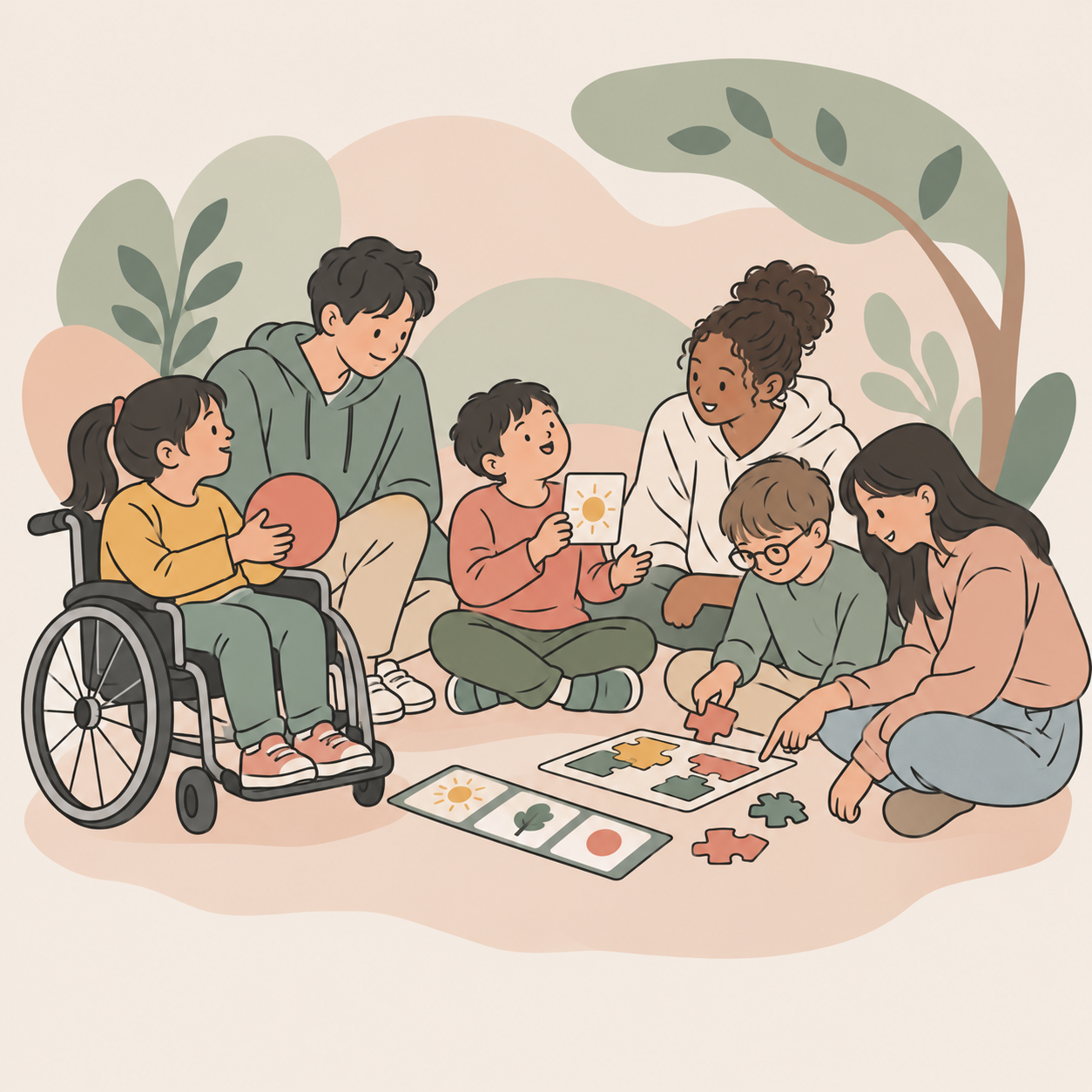
Communication extends far beyond spoken language.
This week, we explored AAC tools, PECS cards, body language, gestures, and other non-verbal cues. We practiced slowing down, presenting clear choices, and allowing enough time for each buddy to respond.
“Communication becomes possible when we learn to listen with more than our ears.”
All ten volunteers attended our second training session, which focused on non-verbal communication and Augmentative and Alternative Communication, commonly known as AAC.
We reviewed several ways children may communicate without relying on spoken words. These included facial expressions, body movements, gestures, eye direction, Picture Exchange Communication System cards, and symbol-based communication boards.
Ethan, an 11th-grade volunteer, reflected on an important lesson: vocal capacity does not equal cognitive capacity. A child who speaks very little—or does not speak at all—may still understand conversations, recognize choices, and have clear preferences.
Sophia practiced navigating a communication board containing 12 symbols. The activity helped us understand that mentors must become familiar with a buddy’s communication system rather than expecting the buddy to adapt to ours.
During our role-play, a buddy pulled a mentor’s wrist toward a locked cabinet. Daniel played the buddy, while Chloe played the mentor. Chloe crouched to the buddy’s eye level, presented two visual choice cards, and waited eight seconds without repeating the question.
The pause initially felt long, but it gave the buddy time to process the options and respond independently. We learned that patient waiting is not passive—it is an essential part of respectful communication.communicate their needs.