

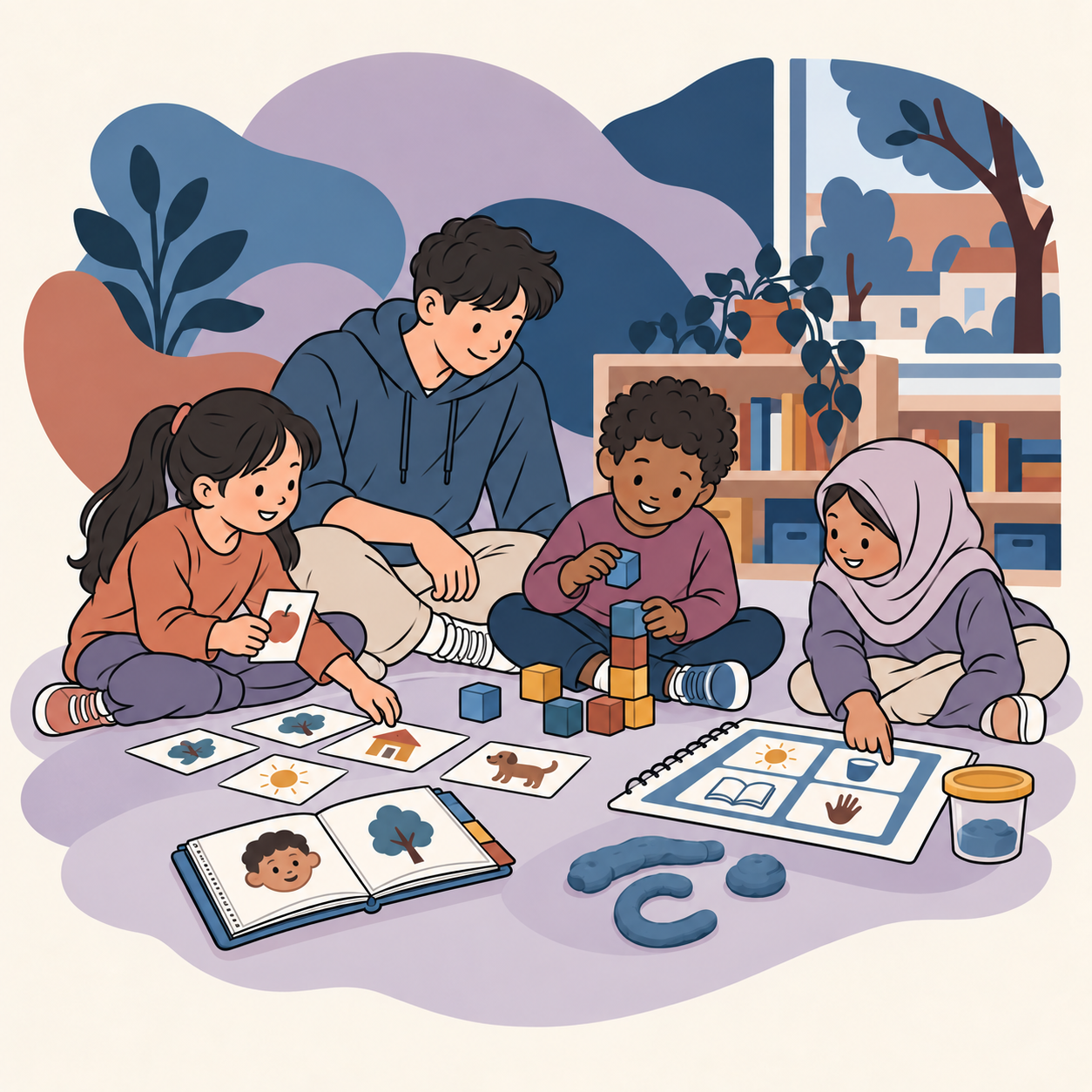
Consistent routines can make a new learning environment feel understandable and secure.
This week, children practiced the letters G, H, and I, feeling words, and counting to ten. Structured choices helped us respond to resistance without creating a struggle for control.
“Trust grows when children know what will happen next and know that their choices matter.”
We opened the session with the same welcome routine used in previous weeks. A visual schedule showed the order of activities, including learning time, a break, and a closing game.
Our literacy work introduced G, H, and I alongside the words “happy” and “safe.” Children could point to an emotion card instead of naming the feeling aloud. For mathematics, we counted to ten using fingers and physical counters.
When a child resisted an activity, we avoided direct commands such as “Do this now.” Instead, we offered two manageable options: letters first or counting first, a red marker or a blue marker. The learning goal remained, but the child retained a sense of control.
Predictability did not mean rigidity. It meant creating enough structure for children to participate without being surprised or pressured.
- Location: City Hope Community, Clarkston, Georgia
- Learners: Refugee children in Grades 1–5 facing trauma, language barriers, and limited prior literacy or numeracy instruction
- Schedule: Once a week, 2.5–3 hours per session
- Learning framework: Safety and grounding → non-verbal and sensory communication → scaffolded literacy and mathematics