

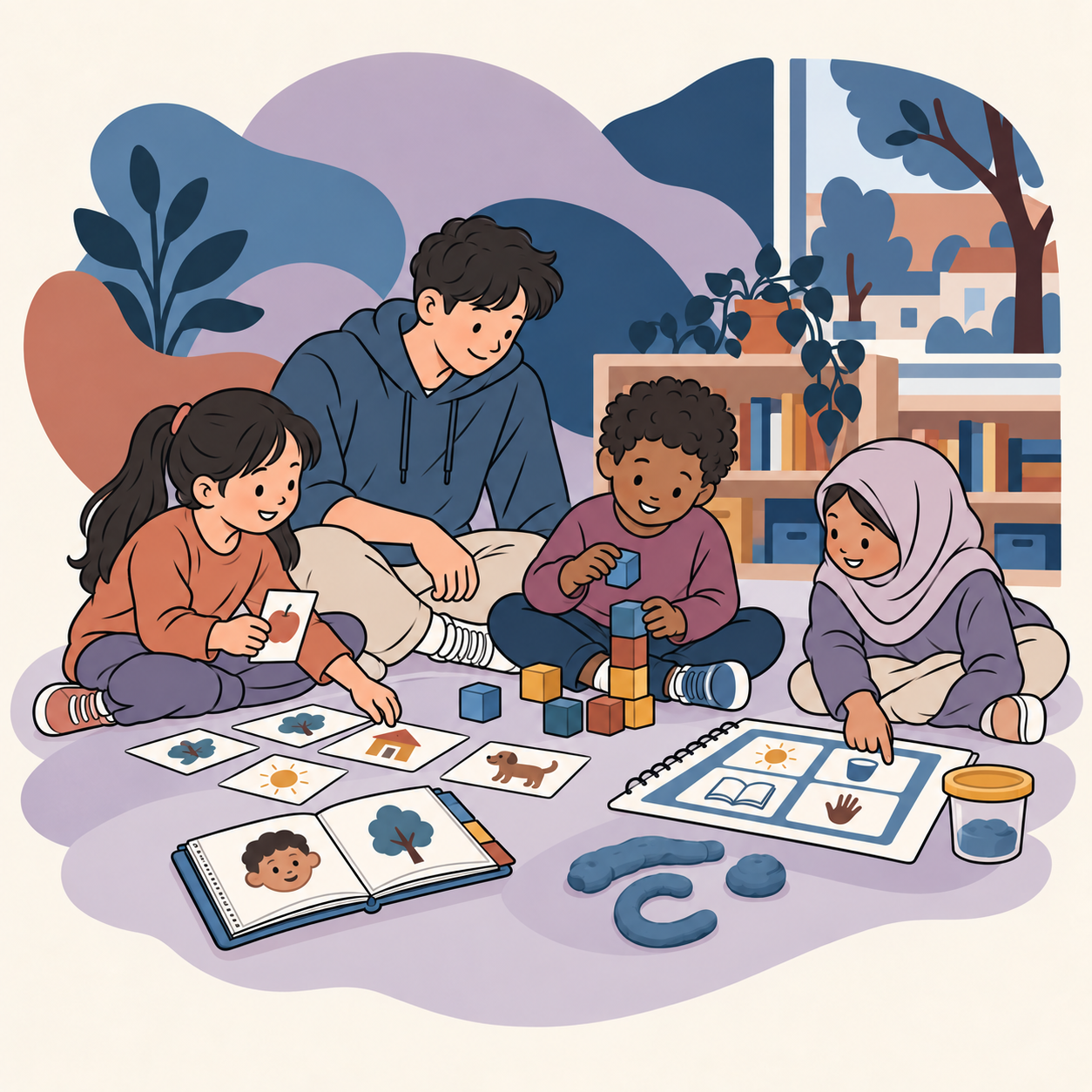
Phonemic awareness can develop through movement, touch, color, and play—not only pencils and paper.
This week, children explored J, K, and L while learning the color words red and blue. Sensory dough made letter formation more approachable for learners who felt anxious about writing tools.
“There is more than one pathway into learning, and every pathway deserves respect.”
Some children were hesitant to hold pencils or complete worksheets, so we introduced soft flour dough as an alternative. Children rolled, pressed, and shaped the dough into the letters J, K, and L while hearing the corresponding sounds.
We also practiced identifying red and blue through dough, cards, and objects around the room. In mathematics, children compared two groups and selected which had “more” and which had “less.”
Sensory materials were offered as an option, not a requirement. Children who disliked the texture could use a plastic tool or keep the dough inside a sealed bag.
The lesson reinforced an important principle: adapting the method does not lower the learning goal. It removes an unnecessary barrier so that the learner can reach it.
- Location: City Hope Community, Clarkston, Georgia
- Learners: Refugee children in Grades 1–5 facing trauma, language barriers, and limited prior literacy or numeracy instruction
- Schedule: Once a week, 2.5–3 hours per session
- Learning framework: Safety and grounding → non-verbal and sensory communication → scaffolded literacy and mathematics