

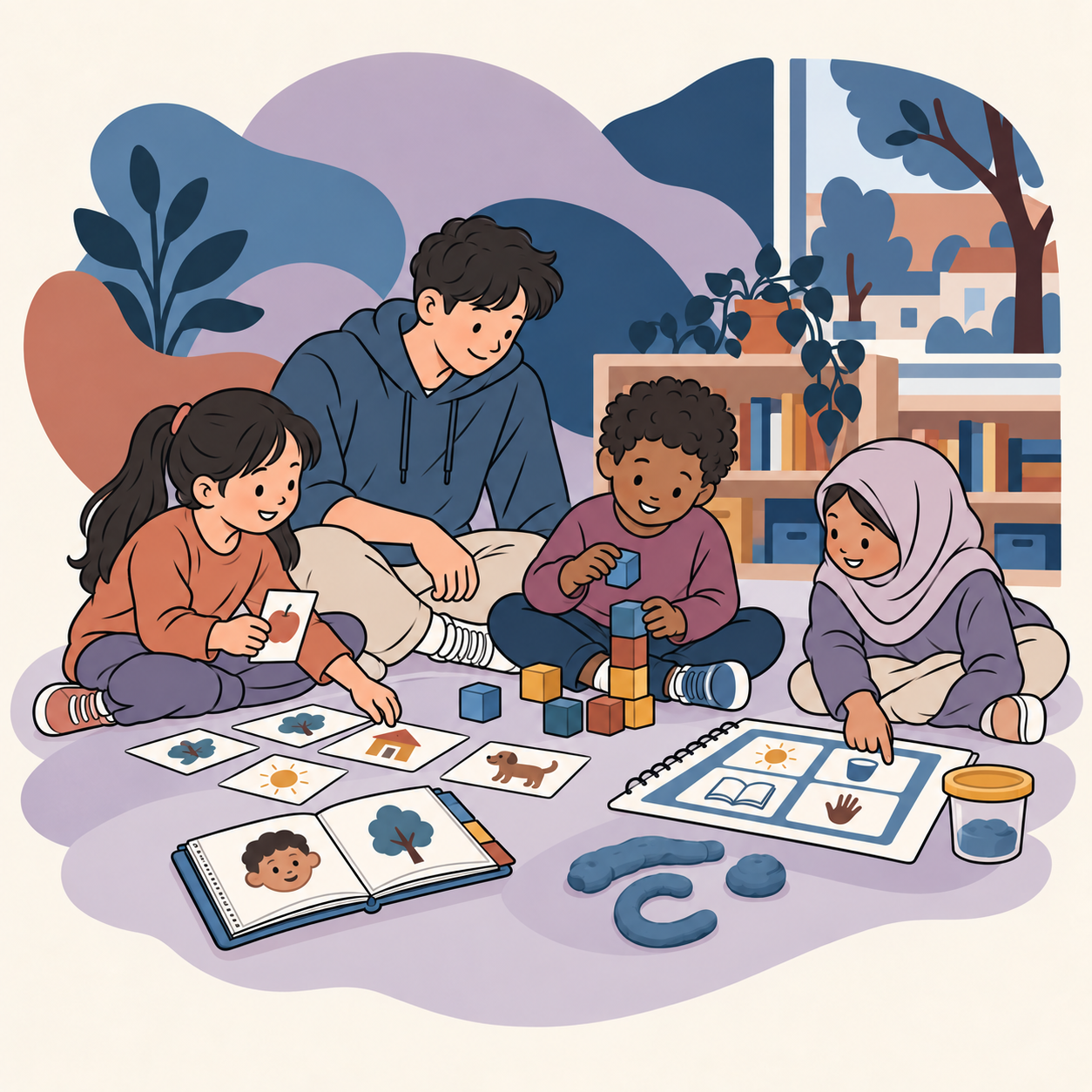
The midpoint of the program gave us an opportunity to review both skills and confidence.
Children practiced S, T, and U, classroom vocabulary, and addition within ten. A visual stamp system made progress visible while keeping encouragement specific and positive.
“Progress becomes powerful when a child can see it, name it, and believe it belongs to them.”
We reviewed the letter sounds introduced during the first eight weeks and added S, T, and U. Everyday classroom objects—such as a book, pencil, chair, and paper—helped children connect English vocabulary with their immediate surroundings.
Mathematics became a game in which children combined counters to make totals within ten. Learners could use objects, fingers, or drawings according to their comfort level.
We introduced a small stamp chart to recognize participation and persistence. Stamps were not removed for mistakes or distress. Instead, children earned them for actions such as attempting a sound, asking for a break, returning to a task, or helping organize materials.
The review showed that growth was not limited to letters and numbers. Greater comfort, communication, and willingness to try were equally meaningful achievements.
- Location: City Hope Community, Clarkston, Georgia
- Learners: Refugee children in Grades 1–5 facing trauma, language barriers, and limited prior literacy or numeracy instruction
- Schedule: Once a week, 2.5–3 hours per session
- Learning framework: Safety and grounding → non-verbal and sensory communication → scaffolded literacy and mathematics