

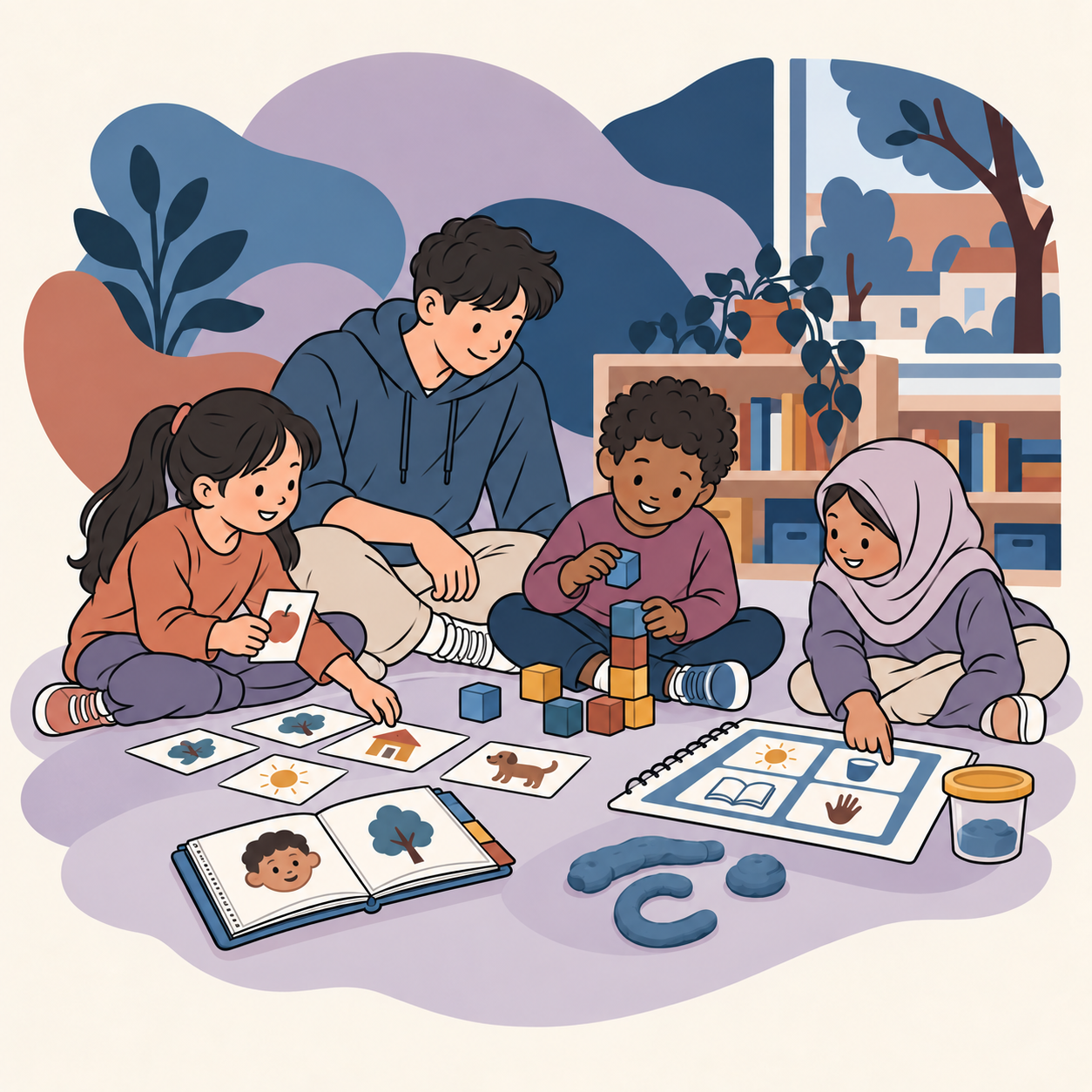
Everyday action words help children understand instructions and express what they are doing.
This week, we practiced short o and u sounds alongside simple verbs. Tasks were divided into small steps so that children could experience success without becoming overwhelmed.
“A task that feels impossible can become possible one clear step at a time.”
Our literacy activities introduced words such as “run,” “sit,” “cut,” and “hop.” Children matched the words to images, acted them out when comfortable, and listened for the short vowel sounds.
For mathematics, we mixed addition and subtraction within ten using blocks and picture cards. A child could first build the quantity, then change it, and finally select the matching number sentence.
Long instructions were broken into micro-steps. Instead of saying, “Choose a card, read the word, draw it, and write a sentence,” we presented one direction at a time and used a visual marker to show completion.
Scaffolding did not mean completing the work for the child. It meant organizing the path so the child could move through it with increasing independence.comfort, communication, and willingness to try were equally meaningful achievements.
- Location: City Hope Community, Clarkston, Georgia
- Learners: Refugee children in Grades 1–5 facing trauma, language barriers, and limited prior literacy or numeracy instruction
- Schedule: Once a week, 2.5–3 hours per session
- Learning framework: Safety and grounding → non-verbal and sensory communication → scaffolded literacy and mathematics