

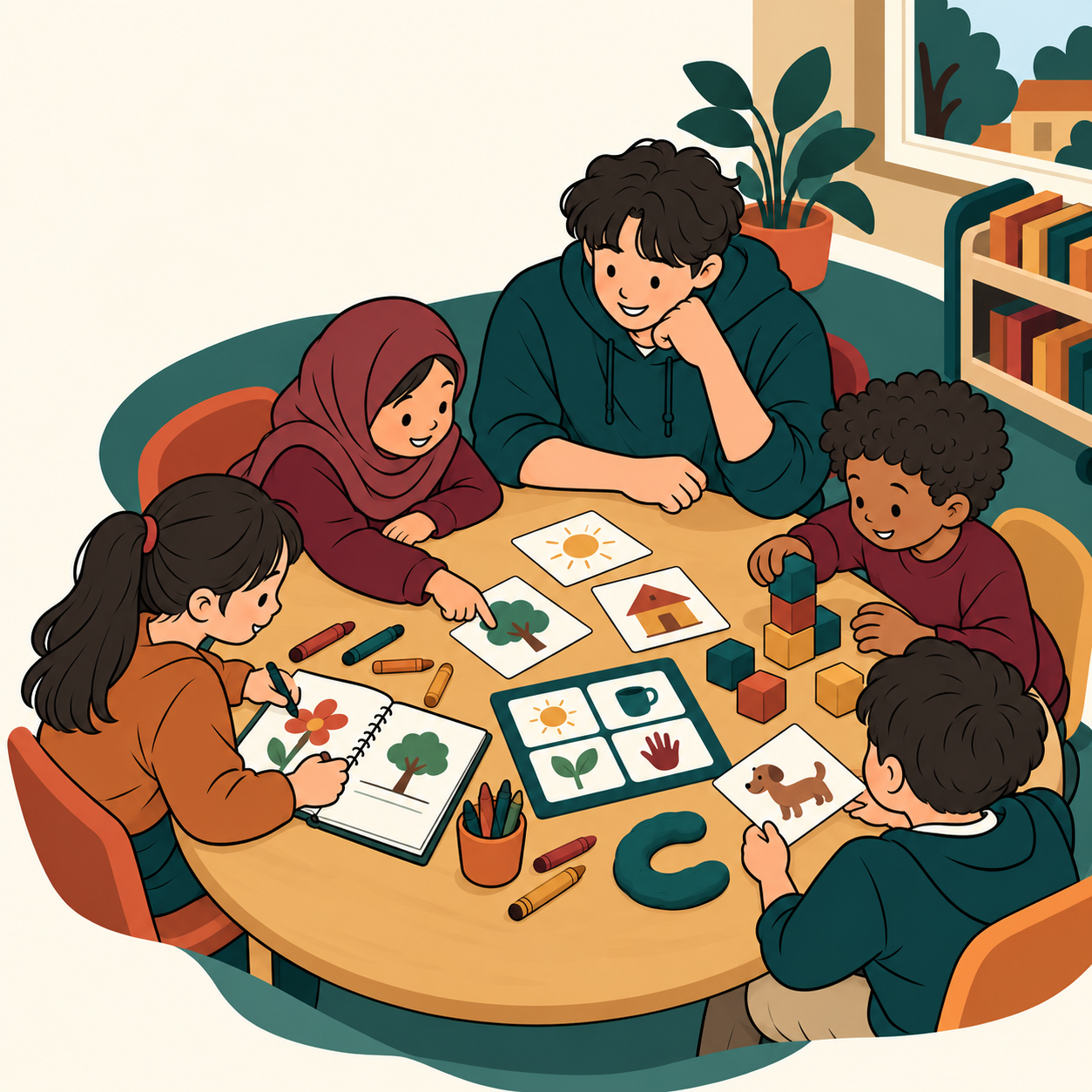
Qais began using English not only to answer questions but also to express his identity.
This week, he wrote and read sentences such as “I like blue” and “I am happy.” Personal choices transformed sentence practice into an exercise in self-advocacy.
“Language became empowering when it allowed him to say not only what he knew, but who he was.”
I introduced sentence frames with picture choices for colors, animals, foods, and emotions. Qais selected his own responses and completed sentences including “I like blue” and “I am happy.”
He read the sentences aloud and added drawings to the page. I resisted correcting every small pronunciation or handwriting error because his meaning was clear and his confidence was growing.
For mathematics, we practiced recognizing and extending patterns. Qais selected colors and shapes to create patterns of his own, giving him another opportunity to make decisions.
His progress was not a transformation from silence into worth. Qais had always possessed preferences, feelings, and ideas. English was becoming an additional tool through which he could make those parts of himself more visible to others.
- Organization: City Hope Community, Clarkston, Georgia
- Student: Qais, an eight-year-old Afghan refugee
- Starting point: No prior English literacy, limited verbal communication, heightened alertness, and significant distress around sudden loud sounds