

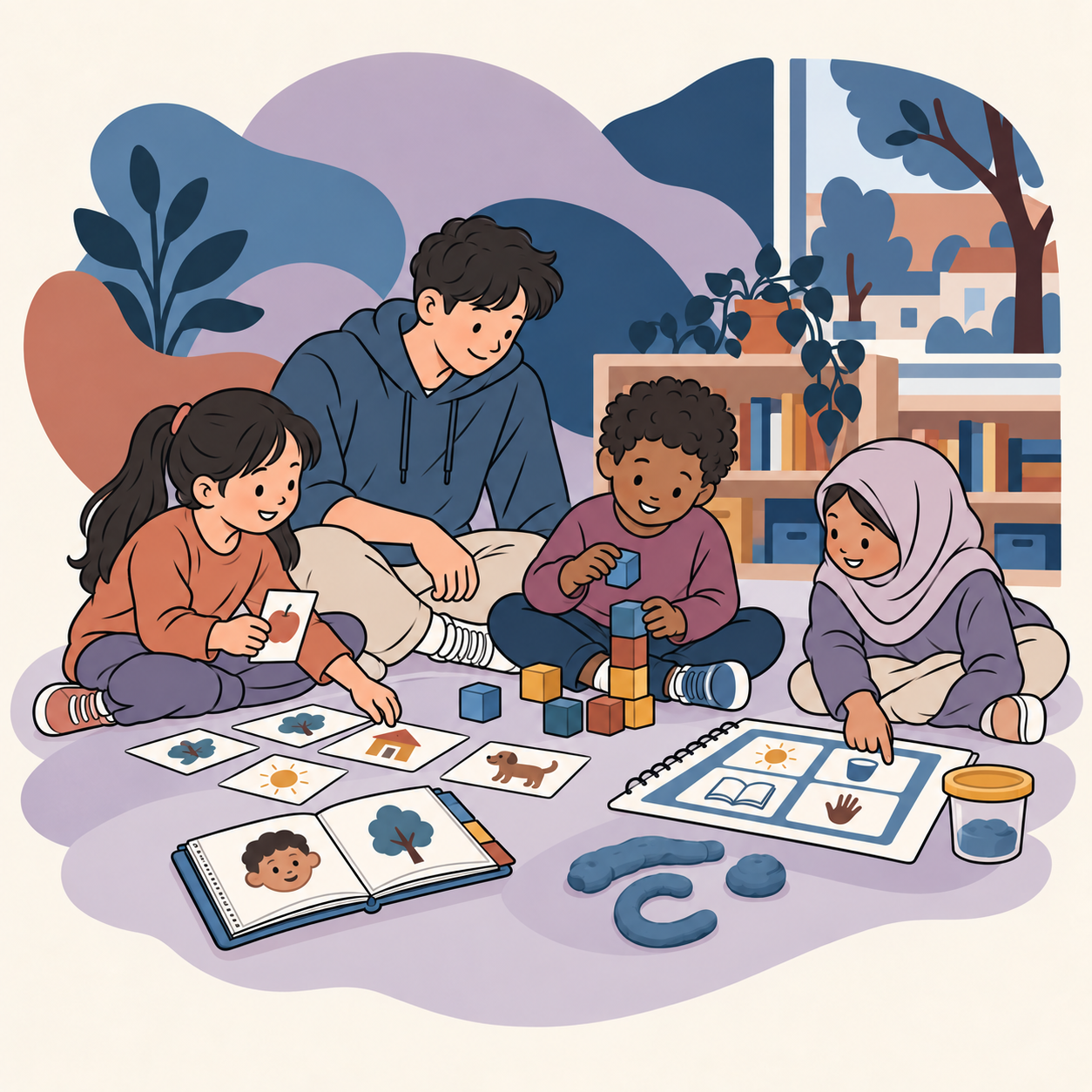
This week moved children from isolated letter sounds toward short-vowel word reading.
We practiced words containing a, e, and i while extending counting to twenty. Peer support helped make challenging tasks feel more social and less intimidating.
“Learning becomes lighter when children discover they do not have to do it alone.”
We began with simple word families and emphasized the middle vowel sound. Children used picture clues and movable letters to construct and read short words at their own pace.
In mathematics, we extended counting beyond ten. Objects were arranged in two groups of ten so that children could see the structure rather than memorize a long sequence without meaning.
We also introduced simple peer-mentoring strategies. Children could take turns selecting a card, demonstrating a count, or helping a partner find a matching picture. Adults monitored the interaction without allowing one child to answer for another.
The session showed that peer learning can support both academic growth and belonging. Each child had an opportunity to be helped and to be helpful.letters and numbers. Greater comfort, communication, and willingness to try were equally meaningful achievements.
- Location: City Hope Community, Clarkston, Georgia
- Learners: Refugee children in Grades 1–5 facing trauma, language barriers, and limited prior literacy or numeracy instruction
- Schedule: Once a week, 2.5–3 hours per session
- Learning framework: Safety and grounding → non-verbal and sensory communication → scaffolded literacy and mathematics