

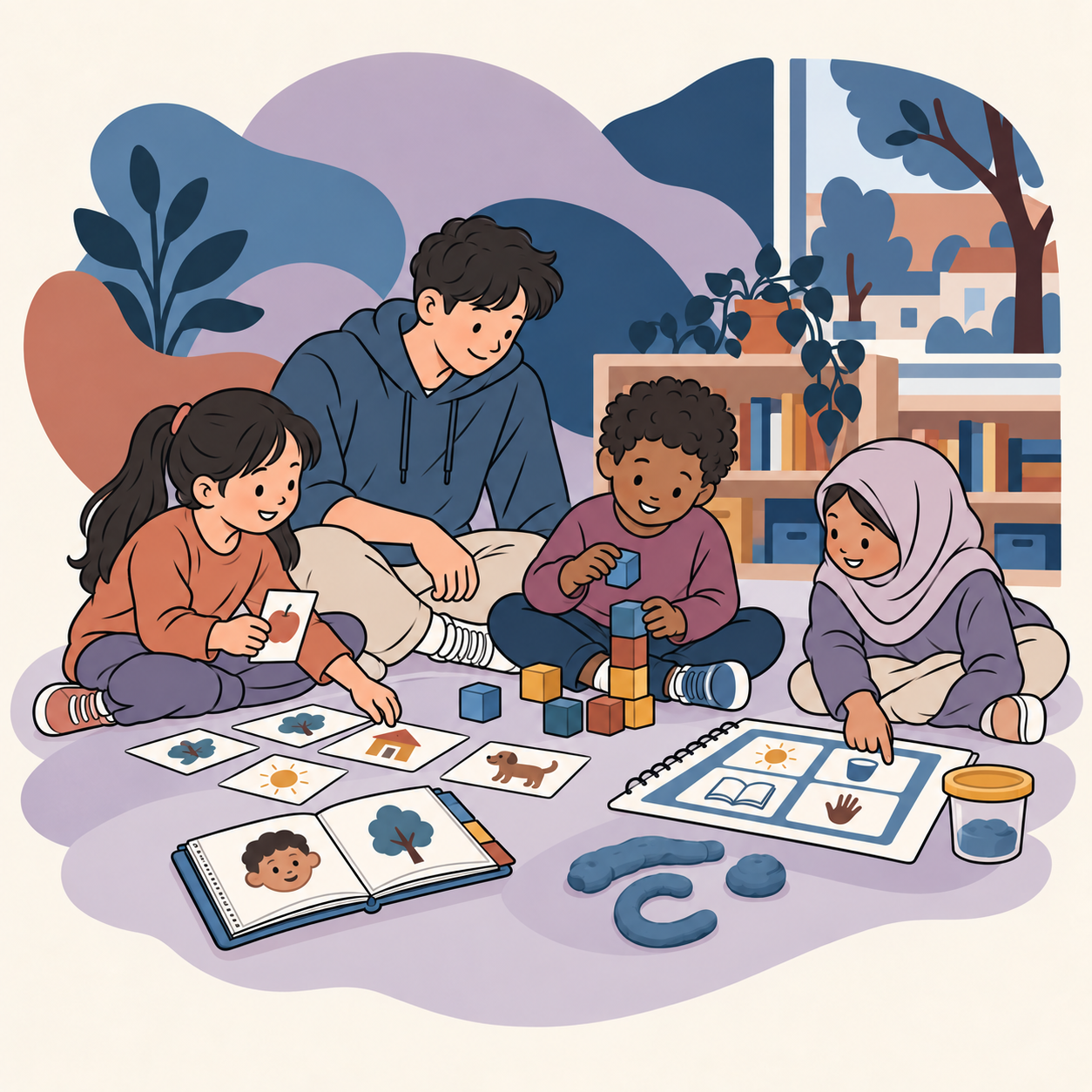
Simple sight words can unlock the experience of reading an entire sentence.
This week, children practiced “I,” “see,” “a,” and “the” while comparing numbers within twenty. We paid particular attention to learners who had begun to believe they were incapable of academic success.
“Confidence returns when a child experiences evidence that effort can lead to success.”
Children arranged sight-word cards into short sentences such as “I see a cat.” Picture support helped them connect the written sentence to meaning before reading it aloud or pointing to each word.
In mathematics, we compared two quantities using physical counters before introducing greater-than and less-than symbols. The goal was to understand the relationship, not merely memorize the direction of a sign.
Some children waited for adults to provide every answer. We responded with manageable prompts, allowed extra time, and celebrated independent attempts. Praise remained specific: “You found the word ‘see’ without help,” rather than a general “Good job.”
Each successful step helped replace learned helplessness with a growing sense of agency.
- Location: City Hope Community, Clarkston, Georgia
- Learners: Refugee children in Grades 1–5 facing trauma, language barriers, and limited prior literacy or numeracy instruction
- Schedule: Once a week, 2.5–3 hours per session
- Learning framework: Safety and grounding → non-verbal and sensory communication → scaffolded literacy and mathematics