

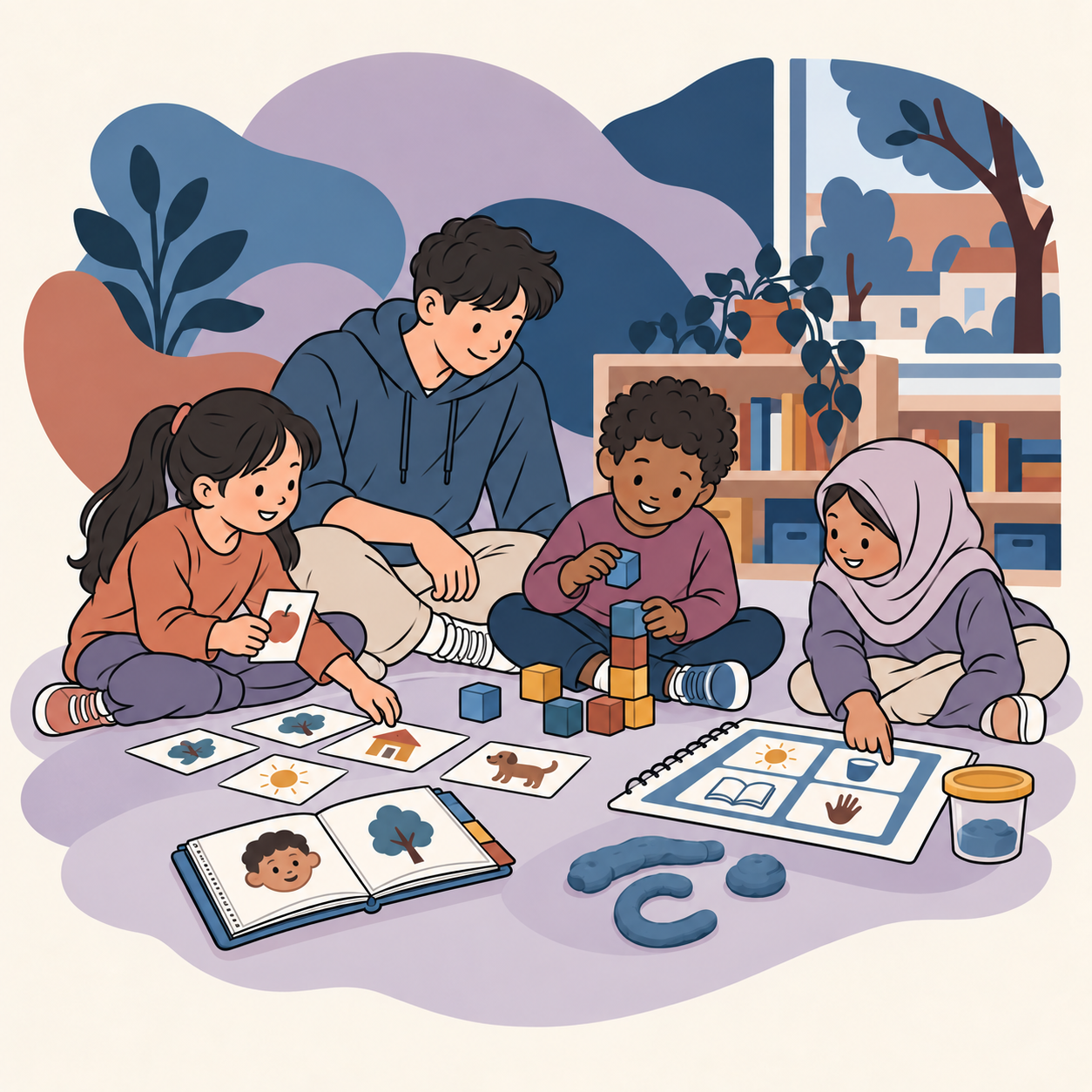
Children can communicate meaningful preferences before they are ready to speak in English.
This week, we introduced the letters A, B, and C alongside pictures, sounds, and physical objects. We also used non-verbal choice boards to give every learner an accessible way to participate.
“A child does not need spoken words to show us what they understand or need.”
Our second session connected early phonics with visual communication. We introduced A, B, and C through sound cards and familiar images, repeating each sound slowly while allowing children to point, match, or simply observe.
For mathematics, children matched the numerals four and five to groups of physical counters. Moving the objects made the relationship between a written number and an actual quantity easier to understand.
We also introduced a small choice board containing symbols such as “break,” “help,” “bathroom,” and “finished.” The board reduced the pressure to speak and gave children more control during the session. When a child pointed to a card, the adult responded consistently so that the symbol developed meaning.
This week reminded us that communication access is not separate from education. It is what makes education possible.
- Location: City Hope Community, Clarkston, Georgia
- Learners: Refugee children in Grades 1–5 facing trauma, language barriers, and limited prior literacy or numeracy instruction
- Schedule: Once a week, 2.5–3 hours per session
- Learning framework: Safety and grounding → non-verbal and sensory communication → scaffolded literacy and mathematics