

Communication difficulties were making ordinary school routines more stressful for Qais.
This week, I focused on practical words he could encounter every day, including “paper,” “glue,” and “scissors.” Grounding and visual sequencing helped make the lesson feel manageable.
“Useful language gives a child more than vocabulary; it gives the child greater control over daily life.”
I began reconsidering what Qais needed most from English instruction. Instead of following an alphabet sequence alone, I introduced school words connected to objects he might need to identify or request.
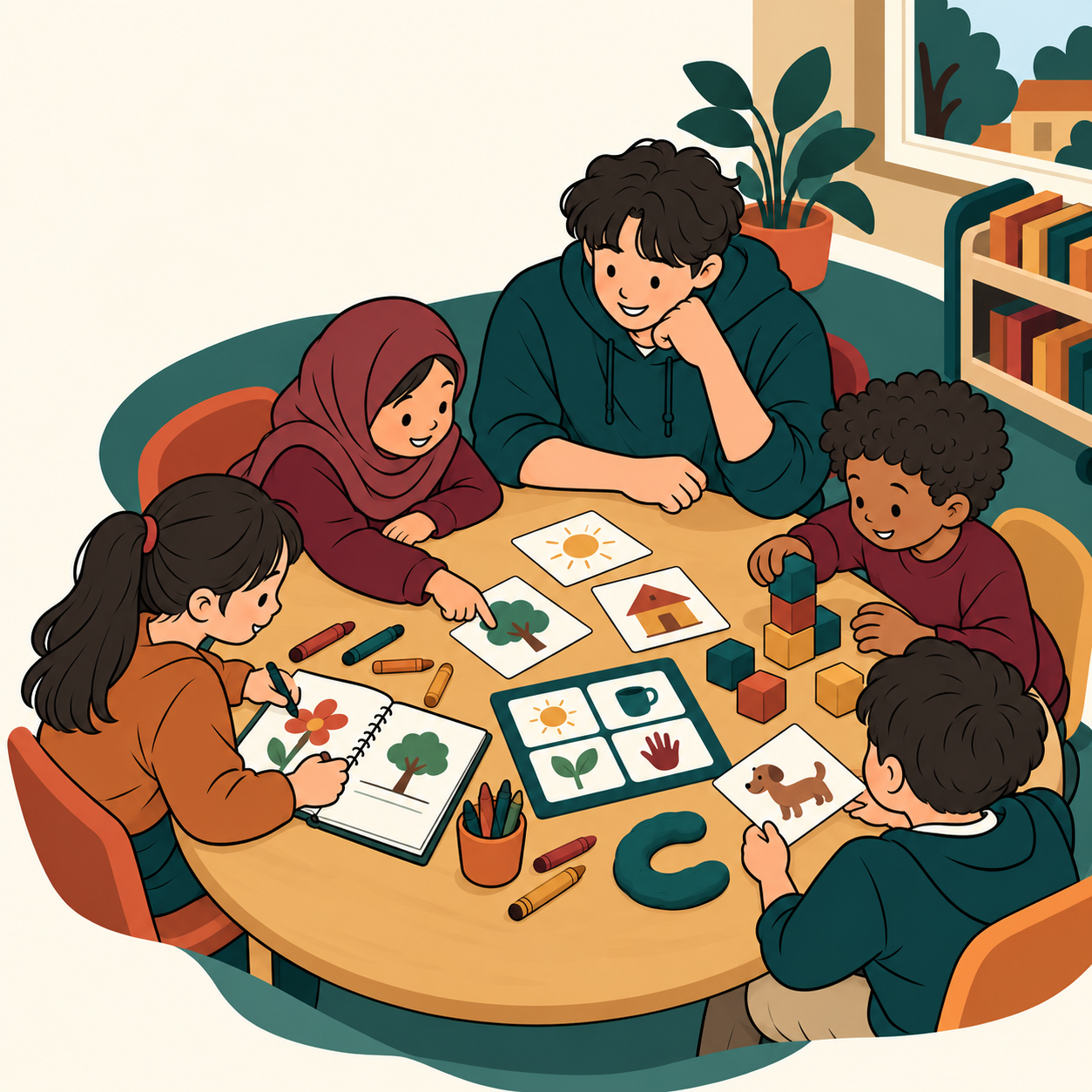
We placed real items beside matching picture cards and spoken words. Qais did not have to repeat each word. He could point, match, or hand me the requested object. This allowed him to show understanding without the added pressure of speech.
For mathematics, we arranged number cards from one to five. When he appeared unsettled, we paused, placed our feet on the floor, and slowly identified objects in the room.
The session reminded me that a curriculum should respond to a learner’s immediate environment. For Qais, practical vocabulary could reduce confusion and make school feel more navigable.
- Organization: City Hope Community, Clarkston, Georgia
- Student: Qais, an eight-year-old Afghan refugee
- Starting point: No prior English literacy, limited verbal communication, heightened alertness, and significant distress around sudden loud sounds