

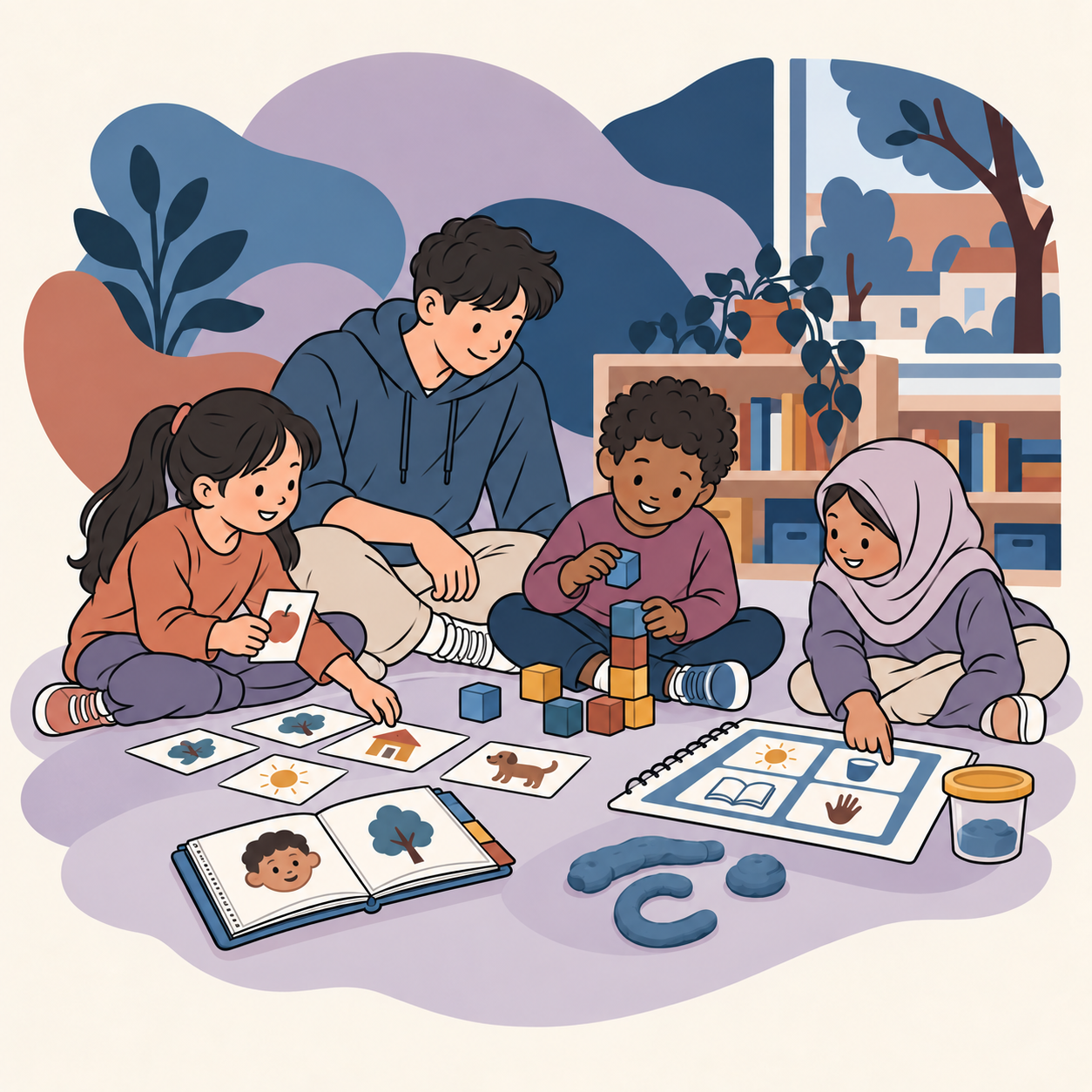
New concepts become more understandable when they connect to familiar people and visible objects.
This week introduced M, N, and O through words related to family and friendship. Children also explored addition by physically combining groups of blocks.
“Abstract ideas become possible when children can first hold them in their hands.”
Our literacy activities focused on the sounds of M, N, and O. We connected them with pictures and familiar words such as “mom,” “name,” and “one,” while acknowledging that families can have many different structures.
For mathematics, children placed two blocks in one group and three in another, then pushed the groups together and counted the total. The plus sign was introduced only after the children understood the action of combining.
Before transitions or potentially loud moments, we showed a visual warning card and counted down. This allowed children who were sensitive to noise or change to prepare or move to a quieter area.
By pairing language and mathematics with concrete experiences, the session helped children participate without relying entirely on spoken explanations.: adapting the method does not lower the learning goal. It removes an unnecessary barrier so that the learner can reach it.
- Location: City Hope Community, Clarkston, Georgia
- Learners: Refugee children in Grades 1–5 facing trauma, language barriers, and limited prior literacy or numeracy instruction
- Schedule: Once a week, 2.5–3 hours per session
- Learning framework: Safety and grounding → non-verbal and sensory communication → scaffolded literacy and mathematics