

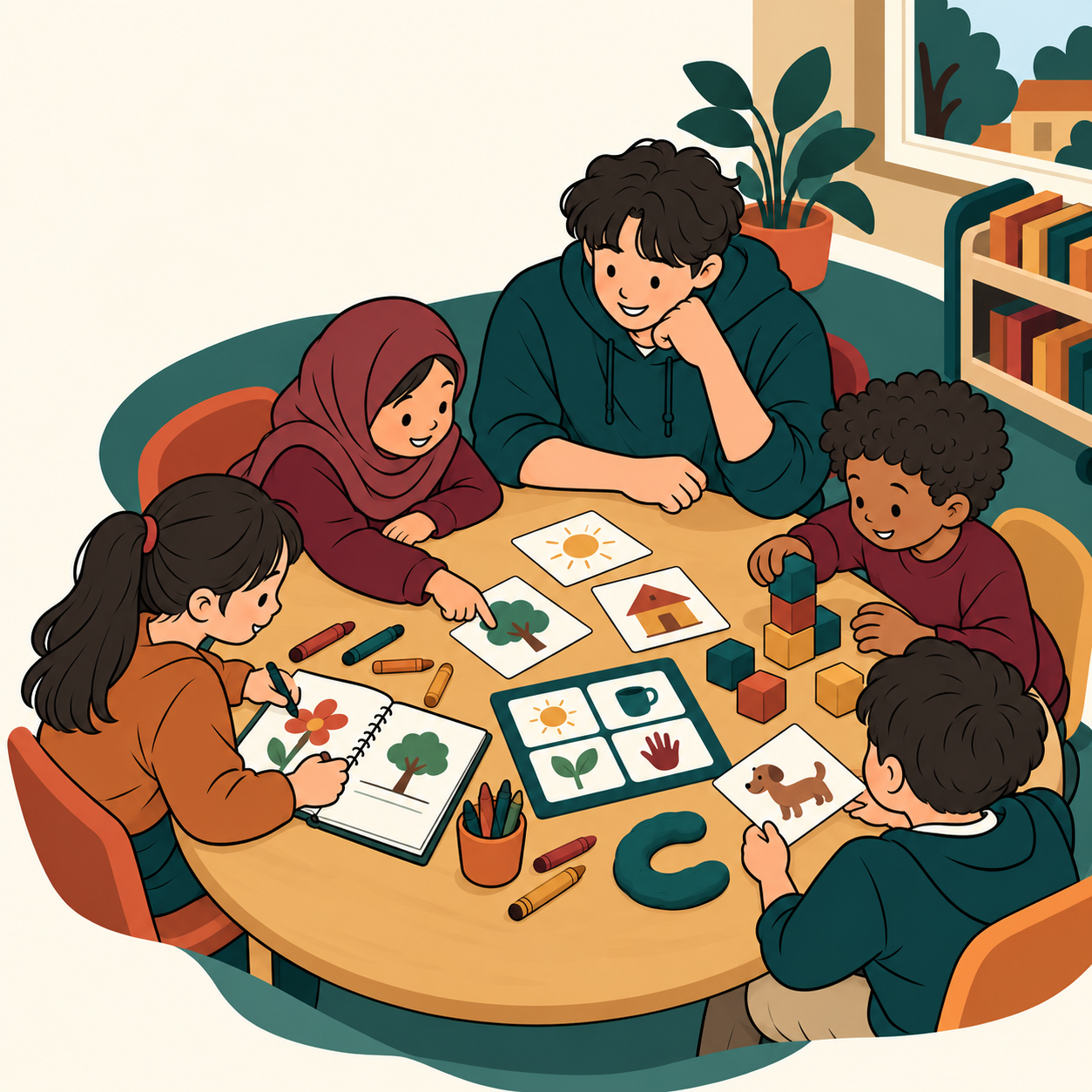
Qais’s knowledge of the alphabet became increasingly independent this week.
He identified letter sounds from A to Z while exploring a pop-up book. We also introduced subtraction through the physical act of removing objects.
“Once safety made room for curiosity, his ability had space to reveal itself.”
Qais moved through an alphabet pop-up book, naming or producing the sound for each letter. Instead of presenting the alphabet only in order, I mixed several cards to check whether he recognized the letters independently.
His responses showed how much he had learned. The child I first met had never lacked curiosity or intellectual potential; those qualities had been difficult to observe beneath fear, unfamiliarity, and limited access to communication.
For subtraction, we began with groups of blocks and physically removed a selected number. Qais counted what remained and matched it to a number card.
Completing the alphabet was an important milestone, but the larger lesson was that behavior during a stressful first meeting cannot define a child’s capacity. Ability often becomes visible only after the environment becomes accessible.possible.ood.ning is not an extra activity. For some learners, it is the most accessible route to the same academic objective.
- Organization: City Hope Community, Clarkston, Georgia
- Student: Qais, an eight-year-old Afghan refugee
- Starting point: No prior English literacy, limited verbal communication, heightened alertness, and significant distress around sudden loud sounds